Upgrade Your Speakers or Treat Your Room First?
You've had your speakers a while. They're kind of delivering, but not really.
So you've been reading up on acoustic treatment. And you've also been looking at that shiny new pair of speakers. (Everybody has a browser tab like that open somewhere.)
Which one gets the money first?
Mike Senior put it nicely when we recorded my latest video. "Shall I get the boring bit or shall I get the nice new shiny bit that looks like I'm actually spending money on something real and electronic?"
People argue both sides of this one. I think both sides are answering the wrong question. You'll probably end up buying both at some point. What actually matters is the order.
Swap the snare, not the mic
Mike came up with the comparison, and it's the best one I know for this.
When you record a drum kit, change the microphone on the snare and you'll hear a difference. Change the snare drum itself and you get a completely different sound.
That's the whole recording chain in one example. First the song, the arrangement, the performers, the instrument. Then the room. Then the microphones. Whatever sits at the top of the chain makes the biggest difference. The further down you go, the less each change does.
Mixing works the same way. First is the material you're given. Then the room it plays back in. Only then the small differences between one speaker and another.
One client, two pairs of speakers, one graph
A client of mine was working on Adam Audio A5Xs. Small two-way speakers with a five-inch woofer. He got curious, swapped them for an older pair of two-way Dynaudios, and measured both at his listening position.
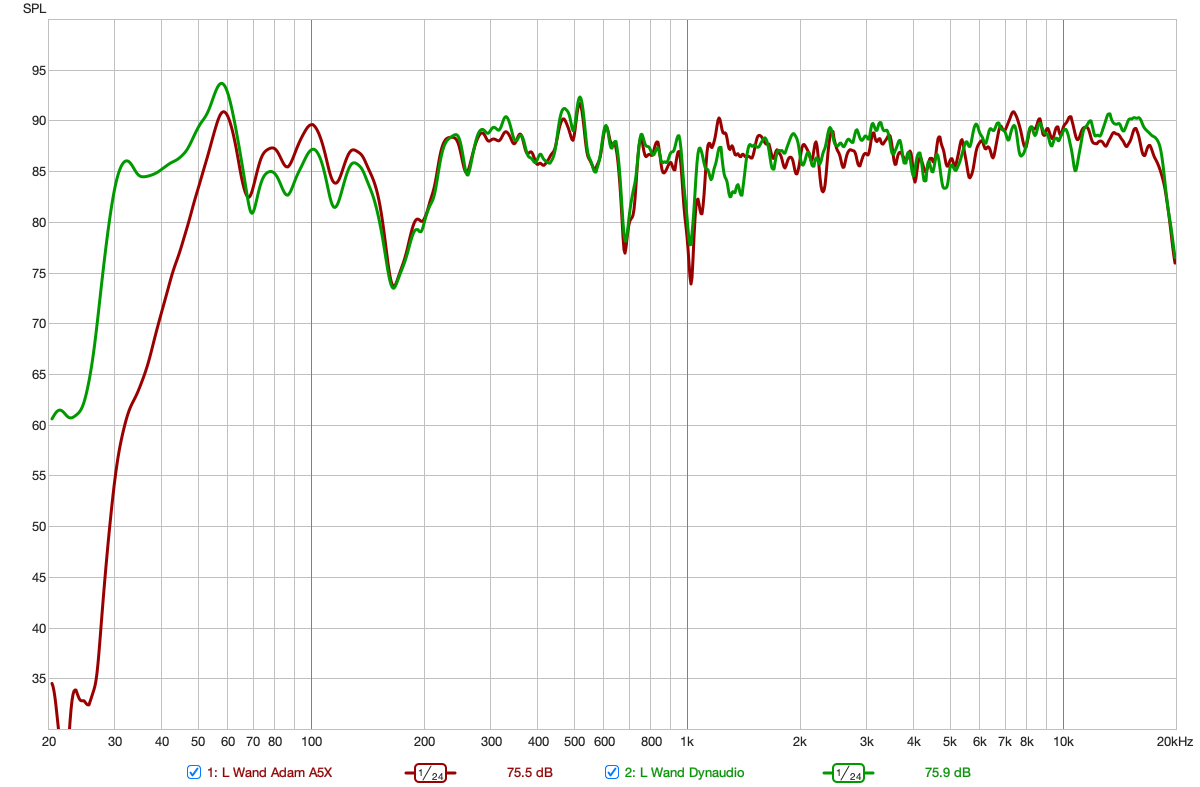
Both responses look almost identical. Honestly, it's pretty impressive.
There's a slight difference in the top end. That comes down to dispersion, the way each speaker spreads its energy into the room at the high mids and highs. And the Dynaudios reach a little deeper in the low end.
That's it. Every peak and every dip the room put into the response stayed exactly where it was.
(He also nailed the placement when he swapped them, which is why the comparison is this clean. Put the new pair somewhere else and you're measuring a different spot in the room, not a different speaker.)
And that's exactly what you'd expect. A well-designed speaker is built to reproduce the signal as unaltered as possible. In practice most of them land within a corridor of one to two decibels. Play the same signal into the same room, and the room responds the same way.
Pretty simple.
The subwoofer that didn't add much
Second example. These measurements came from a pair of Event Opals (sadly discontinued), and the question was whether a Focal CMS sub would add anything useful.
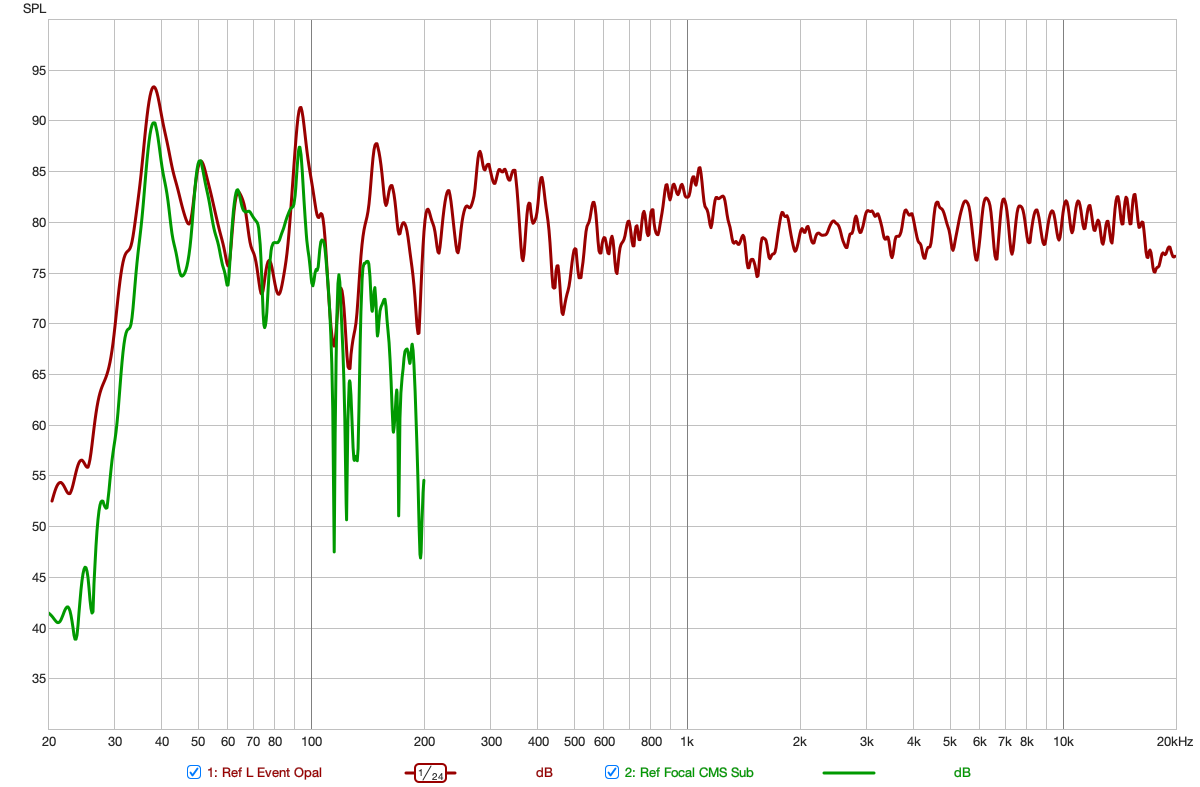
This one is less clear-cut on paper, because the sub couldn't sit exactly where the speaker was. They were roughly a meter, maybe a meter and a half apart, if I remember right.
It barely moved anyway. Low-frequency wavelengths are so long that a meter or so hardly matters to them. The only real change was a bit less impact from the lowest room mode.
Adding the sub would have put more energy into the system overall. More power, sure. But it didn't extend the low end in that room in any useful way. So we decided it wasn't worth it.
What the graphs leave out
So do speakers not matter? They do. Just not in a way these measurements can show you.
A measurement like this tells you whether a speaker is designed properly. It says nothing about the number of drivers, their size, or the materials everything is made of. All of that has a huge impact on how a speaker sounds. Take the graphs with a pinch of salt, as Mike says. They show a very slim part of what you actually hear.
A bigger driver gets you more low-end extension. Going from a two-way to a three-way, with a driver dedicated to the midrange, changes the sound a LOT.
What no speaker can do is fill a hole the room put there. If a dip comes from your room, a perfect speaker gets the same dip. The room has an order of magnitude more impact on what you hear than your choice of speaker.
Where new speakers pay off
Most modern speakers are good enough for proper pro audio work. (Sorry.)
Of course that's a bit unfortunate, because we spend so much time comparing them. But whether your mix translates, whether you can trust what you hear, is a question about your room first.
Once that's sorted, an upgrade starts to pay off. More low end. More focus in the mids. And you notice it in how fast you work, how confident you are in your decisions, how accurate you can be.
Beyond that, it's taste. Remember Grischa's Atmos room from a couple of weeks ago? He got a new room and new speakers at the same time. When he talks about why he mixes faster now, he talks about the room.
Room first, then the shiny pair
So here's the order. Get your speakers and listening position set up properly. Then treat the room. Then, if you still want them, buy the new speakers.
And when you do, you'll actually hear what you paid for.