How Do You Know You’re Sitting in the Right Spot?
There’s one doubt that keeps coming up once a new studio is set up.
The desk is in. The speakers are on their stands. You picked the wall you’re facing, maybe after reading every placement tip out there. But you still can’t shake the feeling. Am I actually sitting in the right spot?
Here’s the uncomfortable answer: Even if you are, it can still sound pretty bad.
In an untreated room you’re not looking for a good spot. You’re looking for the least bad one.
That’s what my latest video with Mike Senior is about. And I think it explains why so many people second-guess their setup for months.
Why is this so hard to know?
Look around for advice and you’ll find plenty on setting up your speakers. Height, toe-in, the stereo triangle. But on where you should sit, there’s almost nothing.
And the little there is mostly assumes a rectangular room. A few weeks ago I wrote that the 38% “rule” only really works in these ideal rooms. But most home studios aren’t that room. Odd corners, a door here, a closet there, a sloped ceiling. No rule of thumb knows about any of it.
So you have to test it in your own room. And that’s where the doubt kicks in. You did the work, you found a spot, and the low end still sounds lumpy. Did you get it wrong? Or is this just what your room sounds like?
Usually it’s the second one.
Two of three decisions are already made
Good news first. The problem is smaller than it looks.
Your listening position has three dimensions. Left to right, up and down, front to back. Two of them pretty much decide themselves.
Left to right, you want symmetry. In a rectangular room that’s the center line. In an odd-shaped room, look for a spot where the room is symmetrical around your setup, even if the rest of it isn’t. Local symmetry. You can find it in most rooms.
Up and down, the only height that matters is your ears. You don’t care what the bass sounds like down in a corner by the floor.
That leaves one question. How far from the wall you’re facing do you sit?
What you're listening for
Think of a room with three or four loud conversations going on at once. Stand next to one group and they drown out everyone else. Stand in the wrong corner and you barely hear anyone. Somewhere in that room there’s a spot where you catch a bit of every conversation, none of them taking over.
Room modes behave a lot like those conversations. Each one is a standing wave at a particular frequency, loud in some places and almost gone in others. Move front to back in your room and the mix of modes you hear keeps changing. Some notes jump out. Others disappear.
What you’re after is the spot where they balance out best on average. I call it the low-end sweet spot. Room modes dominate the low end in any small room, so miss this spot and you’re fighting the room for as long as you work in it.
To find it, I use the Bass Hunter Technique. You put a speaker on the floor in a corner, where it drives every room mode at full strength. Then you play music and move front to back along that center line in your chair, listening for where the bass sounds most even. Not the boomiest spot. Not the thinnest. The one in between. Here’s the step-by-step PDF if you want to go through it yourself.
How do you know you found it?
This is where the “least bad” part comes in.
About a year ago I worked with a client where, as always, we started by finding the best listening position in his untreated room. When we measured the left and right speaker separately, it still looked awful. A huge pile-up at around 100 Hz. A deep dip below it. And the energy underneath that dip never came back up to the level of the rest.
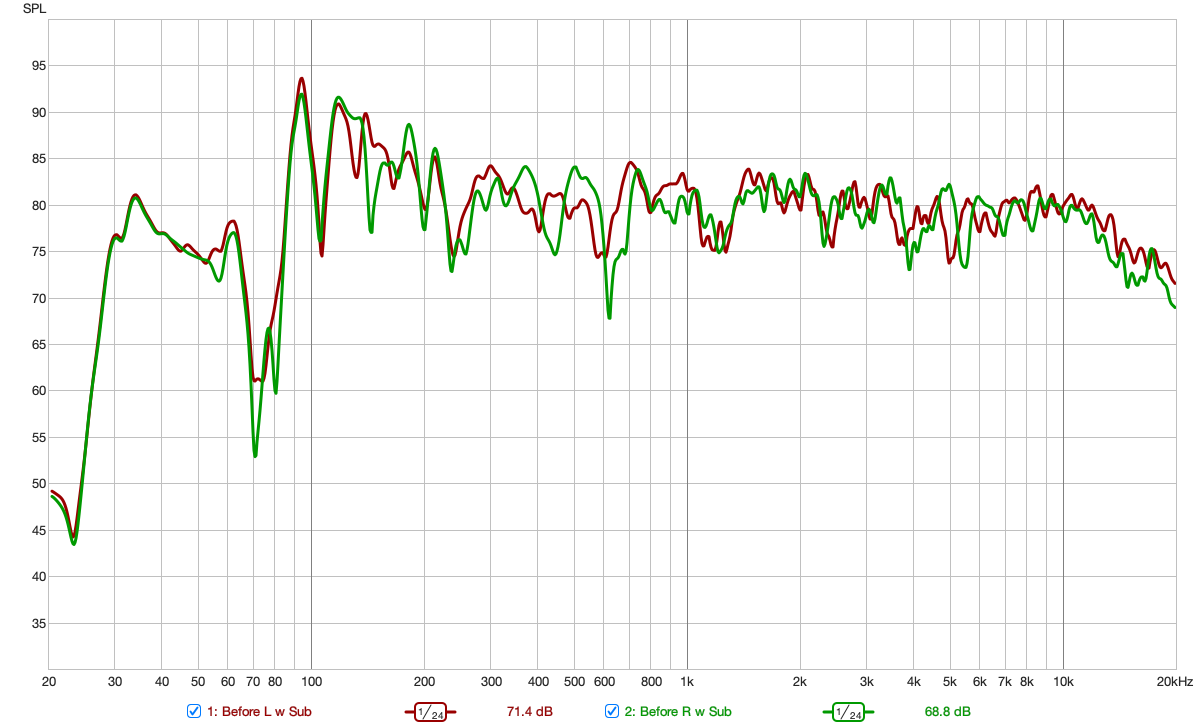
That would sound bad. And it was still the least bad of every option we had.
Fortunately this room is an outlier. Usually it’s nowhere near that bad. A typical untreated room at its low-end sweet spot looks balanced overall, although still with big peaks and dips in the low end.
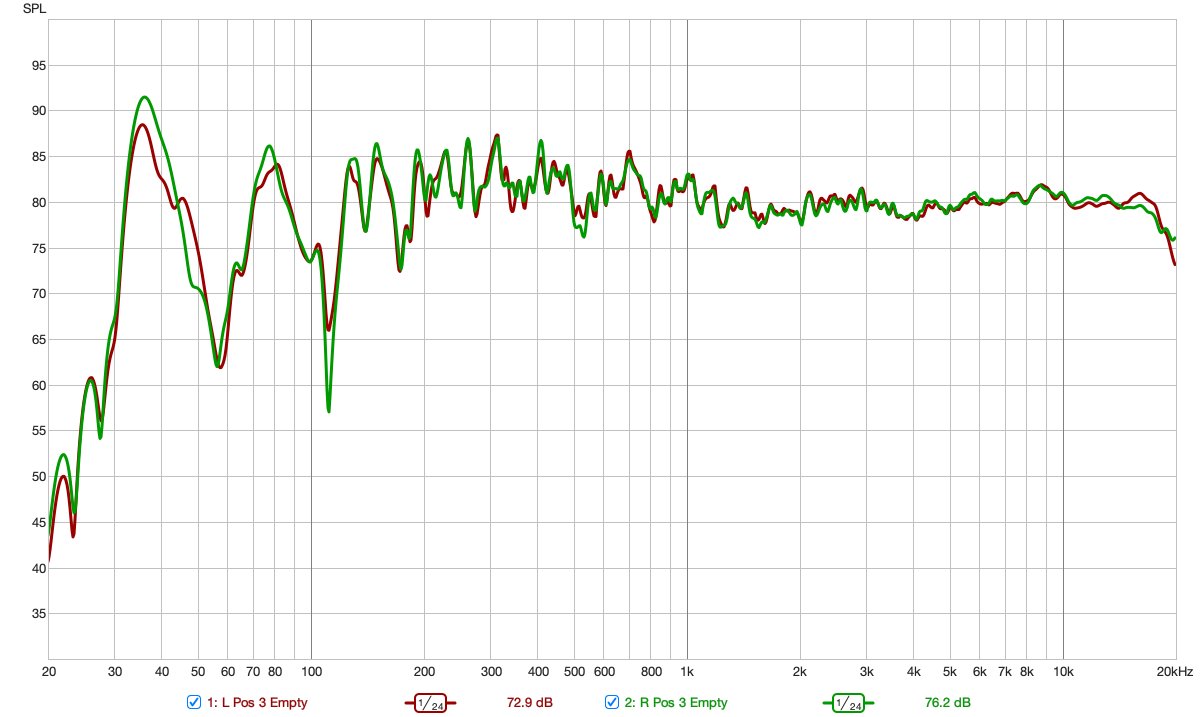
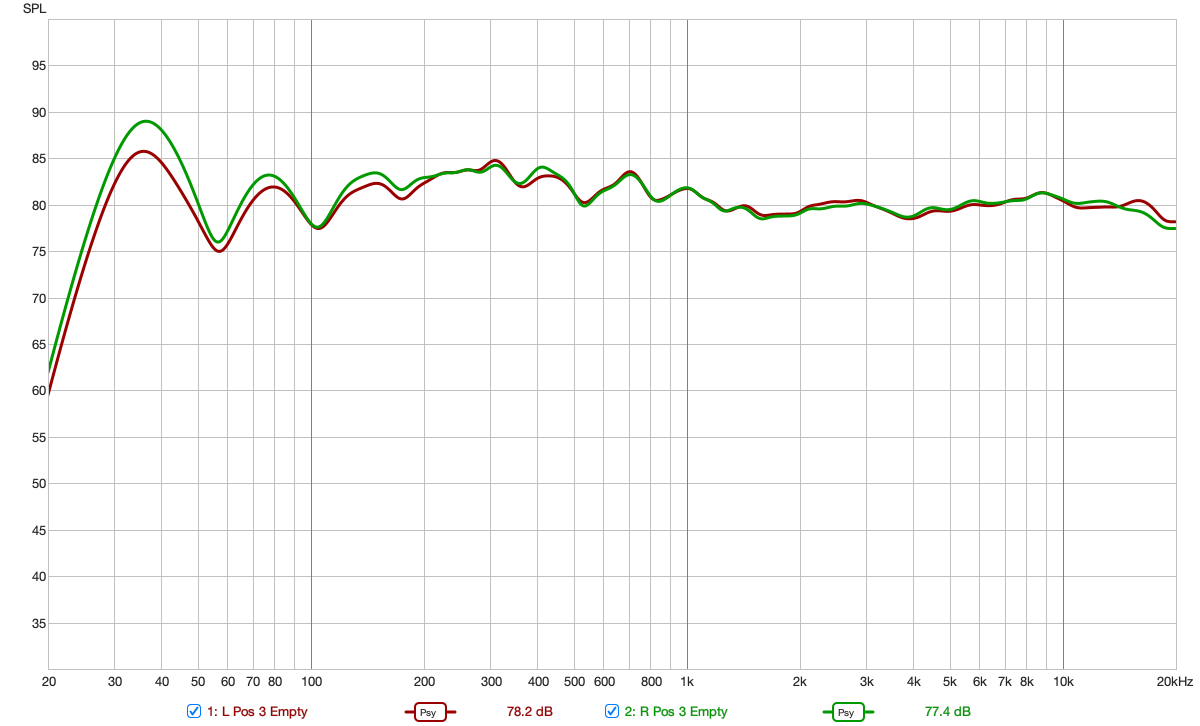
Of course if you haven’t looked at a lot of measurements, even the typical one will worry you. So here’s the check I use. In Room EQ Wizard, apply psychoacoustic smoothing. It’s much closer to what you actually hear than the other smoothing options.
At the right spot, the smoothed curve should roughly look like your speaker. It covers the whole range the speaker plays, down to its own low-end cutoff, without huge humps or holes. You’re not looking for flat! What you want is balanced.
And if you are wondering about that awful example from before? After treatment, measured at the same position, it was back to exactly that kind of balanced response.
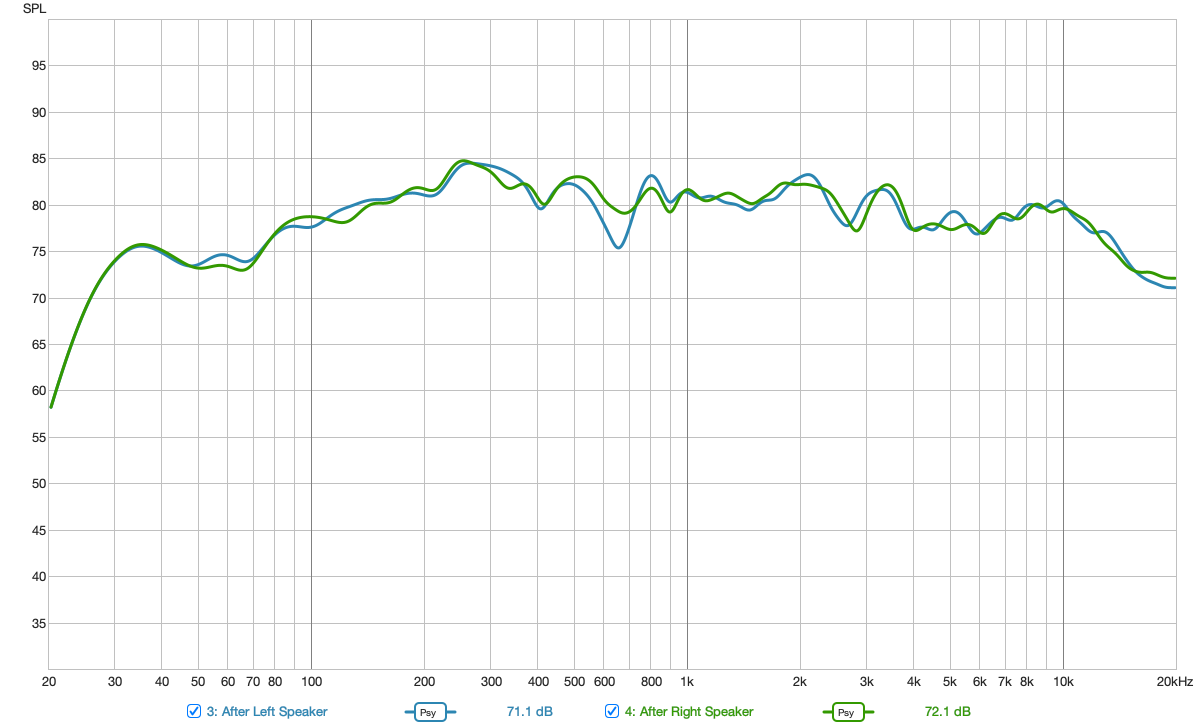
So the spot we picked was right all along. The room just needed help.
Why do it before anything else?
Now, wouldn’t it be easier to find the spot with some treatment already up? Sure, it will make the final result look better. But it actually makes the right spot harder to find in my experience. Reason being, when the low end is really bad, every step forward or back makes a much more obvious difference. If you damp the room first those differences shrink, which can actually make things more confusing.
But the bigger reason is more practical. Your listening position is what everything else gets built around. Speakers go relative to it. Desk, gear and treatment all go around it. If you find out later on that you’ve set up in the wrong spot, you get to rip all of it out and start from scratch.
So find the low end spot first. Set up your speakers from there. Then plan your treatment around what you’ve got.
About half the people I’ve worked with in consulting hadn’t done this before they started treating. When they go back and do it properly, a common reaction is that they could almost work like that without a single panel.
Do you have to tear it all down?
Mike asked the same question a lot of you are probably asking yourself right now.
Here’s when I’d go back and redo it:
- Your low end doesn’t translate. Mixes keep coming out boomy or thin everywhere else. That usually means you’re listening to a low end so bent by your room modes that you can’t make reliable calls on it.
- You never actually tested it. You looked at the floor plan, picked a wall and set everything up. No bueno.
- You could have set up symmetrically in your room, but didn’t. Now if the room really forces you off-center because of the door, a window or the shape of the space, that’s a different story, and treatment and calibration can make up for a lot of it. But if symmetry was possible and you just didn’t go for it, go back.
Start from the least bad spot
Finding your listening position is hard. There isn’t much information out there, and even the right spot can sound rough. So doubting it is normal.
But it’s also the biggest lever you have for a low end you can trust. Bigger than any panel you’ll buy.
So find the least bad spot first. Then build on it from there.